landmarks.im
The Great Wall is many walls
A series of fortifications across northern China, built, joined and rebuilt over some two millennia. The photographs most people know are Ming-period stretches. The official lengths count different things.
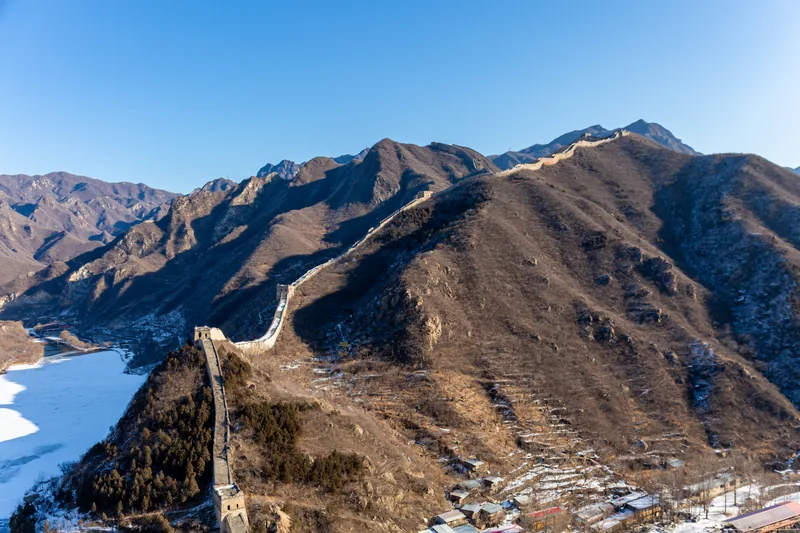
Encyclopaedia Britannica says the Great Wall actually consists of numerous walls — many of them parallel to each other — built over some two millennia across northern China and southern Mongolia. [Britannica]
UNESCO’s Statement of Outstanding Universal Value gives the Great Wall a total length of more than 20,000 kilometres, built from the 3rd century BC to the 17th century AD as the military defence project of successive Chinese empires. [UNESCO] Britannica’s “Top Questions” answer gives the total length of all sections ever built as about 21,196 kilometres (13,171 miles), including overlapping sections that were rebuilt, and the Ming wall as about 8,850 kilometres (5,499 miles). [Britannica]
UNESCO’s official short description says that in about 220 B.C., under Qin Shi Huang, sections of earlier fortifications were joined together to form a united defence system against invasions from the north. [UNESCO] The same official text says construction continued up to the Ming dynasty (1368–1644), when the Great Wall became the world’s largest military structure. [UNESCO]
Start here
Many walls
A desk for the earlier states, the Qin joining, the Han rammed earth, the Ming wall, and the 2012 survey — with a table that stays in view.
Named stretches
From the Old Dragon’s Head at the sea to the fortress at Jiayu Pass, with photographs of real, named places.
Myths and checks
Whether it can be seen from the Moon or from space, set beside what NASA and Britannica actually say — and a line that still appears in UNESCO’s official text.
Sources on this page
- Encyclopaedia Britannica, Great Wall of China (editors’ main article, including the “Top Questions” answers on the same page; checked 15 November 2026)
- UNESCO World Heritage Centre, Statement of Outstanding Universal Value for The Great Wall (list 438); checked 15 November 2026
- UNESCO World Heritage Centre, official short description of The Great Wall (list 438)