Home · Myths and checks
A claim that outran the astronauts
Can you see it from the Moon?
A short answer, then the sources in full: not from the Moon, and only with difficulty — if at all — with the unaided eye from low Earth orbit. Other human-made things are easier to see.
NASA’s 2005 feature “China’s Wall Less Great in View from Space” calls the idea a space-based myth: the Great Wall, frequently billed as the only man-made object visible from space, generally isn’t, at least to the unaided eye in low Earth orbit, and it certainly isn’t visible from the Moon. [NASA]
The theory that the wall could be seen from the Moon, NASA writes, dates back to at least 1938, and was repeated until astronauts landed on the lunar surface. [NASA]
Apollo 12 astronaut Alan Bean is quoted: “The only thing you can see from the Moon is a beautiful sphere, mostly white, some blue and patches of yellow, and every once in a while some green vegetation. No man-made object is visible at this scale.” [NASA]
Kamlesh P. Lulla, then NASA’s chief scientist for Earth observation at Johnson Space Center, said it is very, very difficult to distinguish the Great Wall in astronaut photography, because the materials used in the wall are similar in colour and texture to the land around it. [NASA]
From space, the same feature says, you can see a lot of other results of human activity: perhaps most visible from low Earth orbit are cities at night, and by day major roadways and bridges, airports, dams and reservoirs. [NASA]
Asked whether you can see the Great Wall from space, Britannica answers that you typically can’t: astronauts stated it was not visible with the naked eye from the Moon, and that the structure is only sometimes visible from low orbit and the International Space Station. [Britannica]
A line that is still on an official page
UNESCO’s criterion (i) text still calls the Wall “the only work built by human hands on this planet that can be seen from the moon.” That wording is part of the official statement; later NASA writing, cited on the myths page, does not agree that it can be seen from the Moon. [UNESCO]
We quote that UNESCO sentence because it is still there, not because we think it is the last word. The myths page is for putting the two records in view.
What a satellite image can show
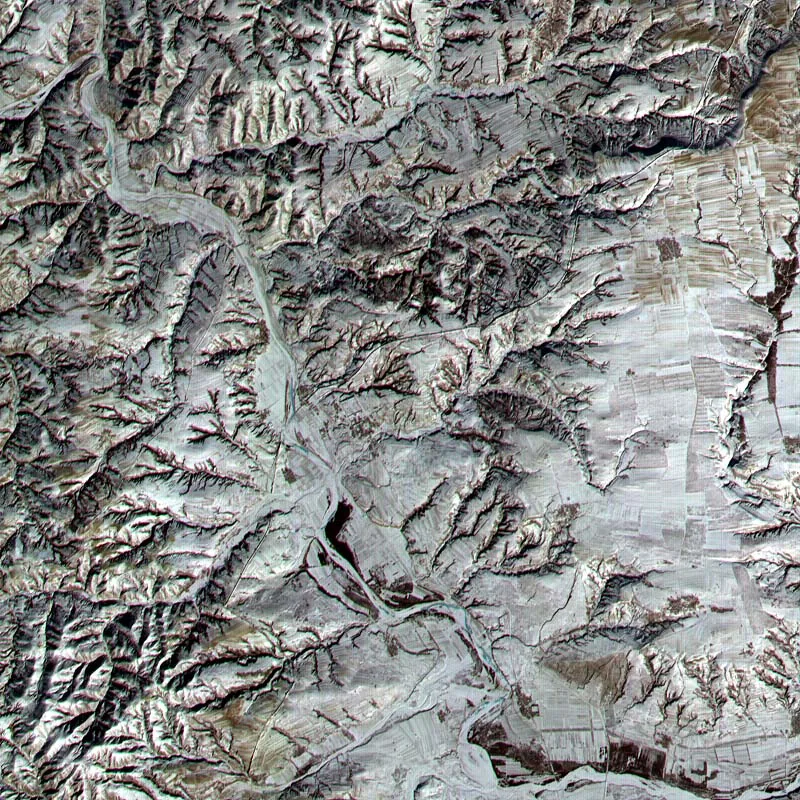
The ASTER image above is a sensor picture of a 12 × 12 km area in northern Shanxi, taken on 9 January 2001. NASA’s own caption says the low sun angle and light snow cover highlight a section of the wall, visible as a dark line running diagonally. That is not the same as standing on the Moon, or looking out of a spacecraft window with the unaided eye.
It is not one wall, either
Encyclopaedia Britannica says the Great Wall actually consists of numerous walls — many of them parallel to each other — built over some two millennia across northern China and southern Mongolia. [Britannica]
The BBC describes the Great Wall as a series of walls and earthen works begun in 500 BC and first linked up under Qin Shi Huang in about 220 BC. [BBC News]
Sources on this page
- NASA, “China’s Wall Less Great in View from Space” (feature dated 9 May 2005; historical copy checked 15 November 2026)
- Encyclopaedia Britannica, Great Wall of China (editors’ main article, including the “Top Questions” answers on the same page; checked 15 November 2026)
- UNESCO World Heritage Centre, Statement of Outstanding Universal Value for The Great Wall (list 438); checked 15 November 2026
- BBC News, “China’s Great Wall is ‘longer than previously thought’” (6 June 2012), reporting a State Administration of Cultural Heritage survey via Xinhua